How plate heat exchangers work
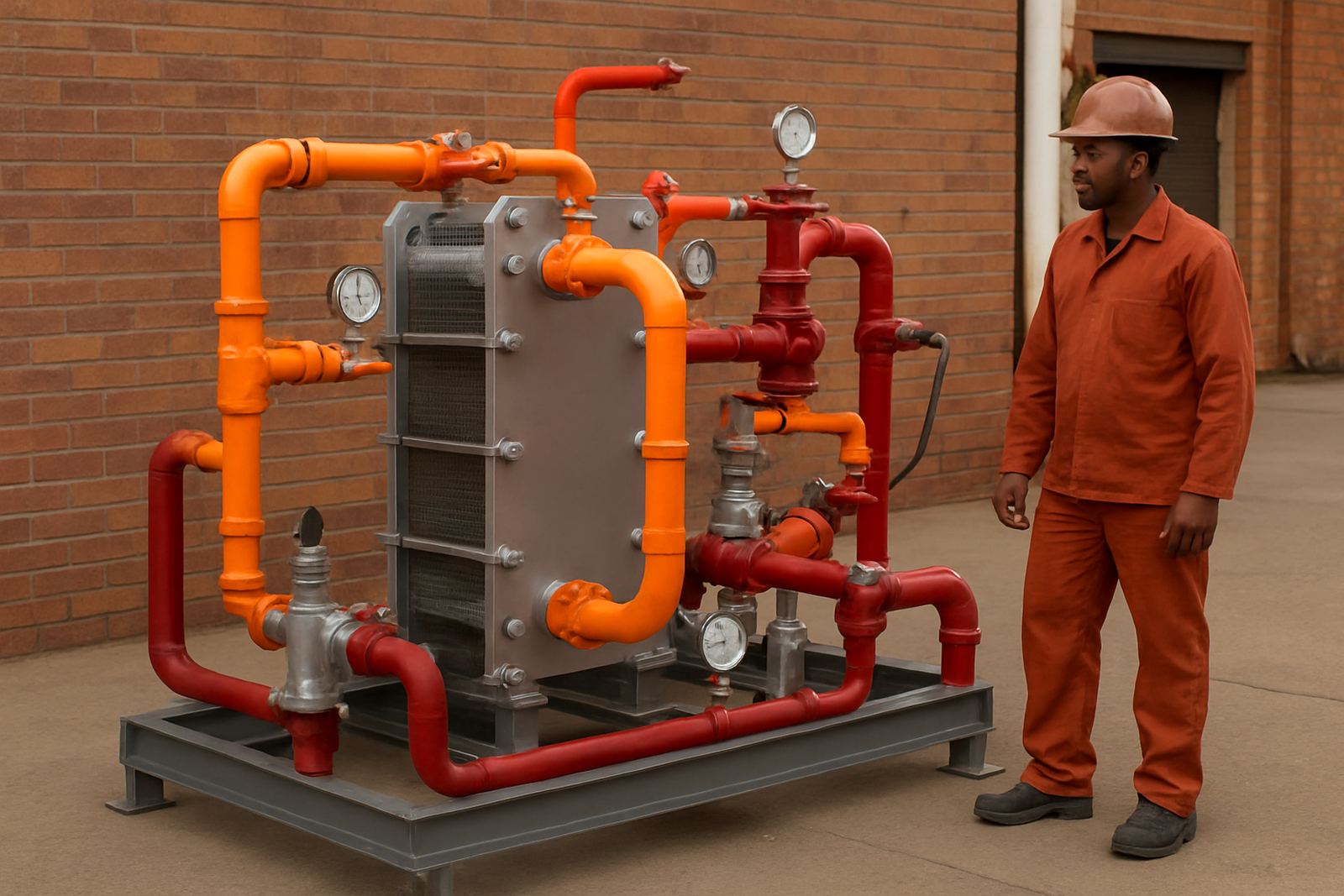
A plate heat exchanger uses a stack of thin corrugated plates clamped inside a frame. Hot fluid flows on one side of each plate and cold fluid flows on the other, so heat transfers through the plate wall while the two streams stay separate. This makes it a practical choice where you need fast heat transfer in a small footprint and where the process can be opened for cleaning later.
For South African sites, that matters in plant rooms with tight access, on factory floors where space is taken up by pumps and filters, and in buildings that have to keep running during load-shedding. The exchanger itself does not burn fuel. It works with a hot source such as boiler water, hot process water, solar heated water, or waste heat, then transfers that energy into a secondary circuit. Flow rates, temperatures and pressure drop need to be matched properly, otherwise the unit can underperform or cause nuisance trips on the pumps.
Common sizes and plate options
Plate heat exchangers are selected by duty, not only by physical size. Small units may handle a few kW for water heating, while larger framed units can deal with hundreds of kW or more on process and plant duties. The frame size, plate count, port size and plate pattern all affect performance. We can supply gasketed plate exchangers with removable plates for cleaning, or semi welded arrangements where certain fluids need more separation. For dirty water, hard water or systems with scale risk, the plate gap and material choice become important.
- Connection sizes from small bore plant pipework up to larger flanged duties
- Plate materials for water, glycol and selected process fluids
- Gasket materials suited to temperature, chemical exposure and service interval
- Frames that can be opened for inspection, plate washing and gasket replacement
- Designs for counterflow arrangements to improve heat transfer efficiency
In coastal areas with higher humidity and salt in the air, frame finish and external corrosion control should be considered at the ordering stage. On inland industrial sites, the bigger concern is often dust, vibration and water quality.
Where plate heat exchangers fit best
These exchangers suit a wide range of commercial and industrial applications. They are often used for hot water generation, process heating, boiler isolation, hydraulic cooling, glycol loops, calorifier support and temperature control on wash plants. They are also useful where you need to separate open and closed circuits, such as a clean secondary loop from a dirty primary source. In some plants they help recover heat from waste streams instead of dumping that energy to drain or atmosphere.
- Factories with washdown systems and repetitive heating cycles
- Hotels, hospitals, apartment blocks and other buildings with domestic hot water demand
- Food and beverage plants where cleanable heat transfer is needed
- Mining and heavy industry where water quality changes and maintenance access is limited
- Boiler houses needing separation between the boiler circuit and the load circuit
They work well where space is tight and downtime costs money. If the duty involves very dirty slurry, fibrous solids or heavy scaling without routine cleaning, a plate exchanger may not be the right answer and a shell-and-tube or other arrangement may be better.
Installation needs and site connections
A plate heat exchanger needs correct pipework, isolation valves, strainers, vents and drain points. It should be installed where the plates can be removed for service and where there is enough clearance for maintenance tools and lifting. The foundation or wall support must take the operating weight, especially on larger framed units with water inside. Flow direction, temperature sensors and control valves should be set up to suit the duty, not just to fit into the nearest open space.
There is no direct gas requirement at the exchanger itself, but the heat source feeding it may be a boiler or other thermal plant that does use gas, diesel, steam or electric heating. The exchanger also depends on the circulation pumps and control system. On sites with load-shedding, standby power or load control should be checked so the pumps keep moving when the building is under pressure. If the unit is part of a municipal or industrial water system, any backflow, discharge or chemical dosing arrangement must comply with site rules and local by-laws.
- Install strainers before the exchanger to catch grit and welding debris
- Allow straight access for plate removal and gasket inspection
- Fit temperature gauges or probes on both sides for quick fault finding
- Use correct isolation valves so the unit can be taken out without draining the whole plant
Care, cleaning and servicing
Most plate exchangers fail early because the system water is neglected. Scale, sludge and corrosion products reduce flow and transfer rate, then the pumps work harder and the temperature difference gets worse. Routine care should include strainer cleaning, water quality checks, pressure drop checks and visual inspection for external leaks. Gaskets should be inspected for hardening, flattening and seepage. If the unit is opened, plates must be cleaned properly and reassembled in the correct sequence.
Ai-TEC supports cleaning, maintenance and repairs on plate heat exchangers as part of broader plant service work. We also look at the linked boiler, calorifier or process line, because the exchanger is only one part of the system. On Gauteng sites we can assist from Jet Park, Boksburg and service areas including Kempton Park, Germiston, Midrand, Sandton and Pretoria. National teams can be arranged for larger shutdowns and planned maintenance. Annual checks are worth the effort, because a small leak or blocked plate pack can turn into a full plant interruption if it is left too long.
What to check before you order
Before ordering, gather the operating data rather than guessing the size. The duty depends on inlet and outlet temperatures, flow rates, allowable pressure drop and the type of fluid on each side. You should also confirm whether the unit must be easy to strip for cleaning, whether the process fluid is clean or fouling, and whether the duty changes seasonally. A unit sized for winter hot water may be undersized for peak summer demand if the process load shifts.
- Hot side and cold side fluid type
- Inlet temperature and target outlet temperature
- Flow rate on each circuit in litres per minute or cubic metres per hour
- Maximum pressure and allowable pressure drop
- Whether the system needs gasketed, semi welded or special plate construction
- Space available for installation and future maintenance access
If you are replacing an older unit, send photos of the nameplate, connection layout and current pipework. That saves time and helps avoid a mismatch on ports, frame size or lifting arrangement. It is also worth checking pump condition, water treatment and insulation at the same time, because a new exchanger will not fix a neglected system on its own.
Key facts
| Product type | Compact plate heat exchanger for indirect heat transfer |
|---|---|
| Construction | Clamped plate pack in a serviceable frame |
| Typical duties | Hot water generation, process heating, cooling and heat recovery |
| Materials | Stainless or suitable plate and gasket combinations for the duty |
| Connections | Threaded or flanged, sized to match plant flow requirements |
| Service support | Supply, installation support, cleaning, maintenance and fault finding |