What an inline water heater does
An inline water heater heats water as it passes through the unit, so you do not depend on a large storage cylinder sitting at temperature all day. That makes it useful where plant space is tight, demand is uneven, or you need hot water quickly at the point of use. In commercial settings, this can help cut standing heat losses and reduce the strain on old hot water systems that are already carrying too much load.
These heaters are commonly used with wash basins, change rooms, process lines, canteens and staff ablution blocks. They can form part of a central plant or serve a single line where the run is short and the flow demand is predictable. For sites in Gauteng that deal with load-shedding, water pressure swings or variable shift patterns, inline heating often gives better control than an oversized storage setup that is slow to recover.
Sizes, ratings and build options
Inline water heaters are specified by flow rate, temperature rise and the energy source available on site. A small handwash unit may only need modest output, while a production or hospitality application may need a much higher kilowatt rating and heavier duty controls. The right size depends on inlet water temperature, litres per minute required and the target outlet temperature.
- Typical flow ranges: about 5 to 60 litres per minute, depending on model and temperature rise.
- Common electrical options: single phase and three phase supply, subject to site load and breaker size.
- Gas-fired options: suitable where gas is already approved and ventilation can be provided.
- Materials: stainless steel, copper and steel assemblies depending on duty and water quality.
- Controls: thermostat control, high limit cut-out, flow switch and local isolation.
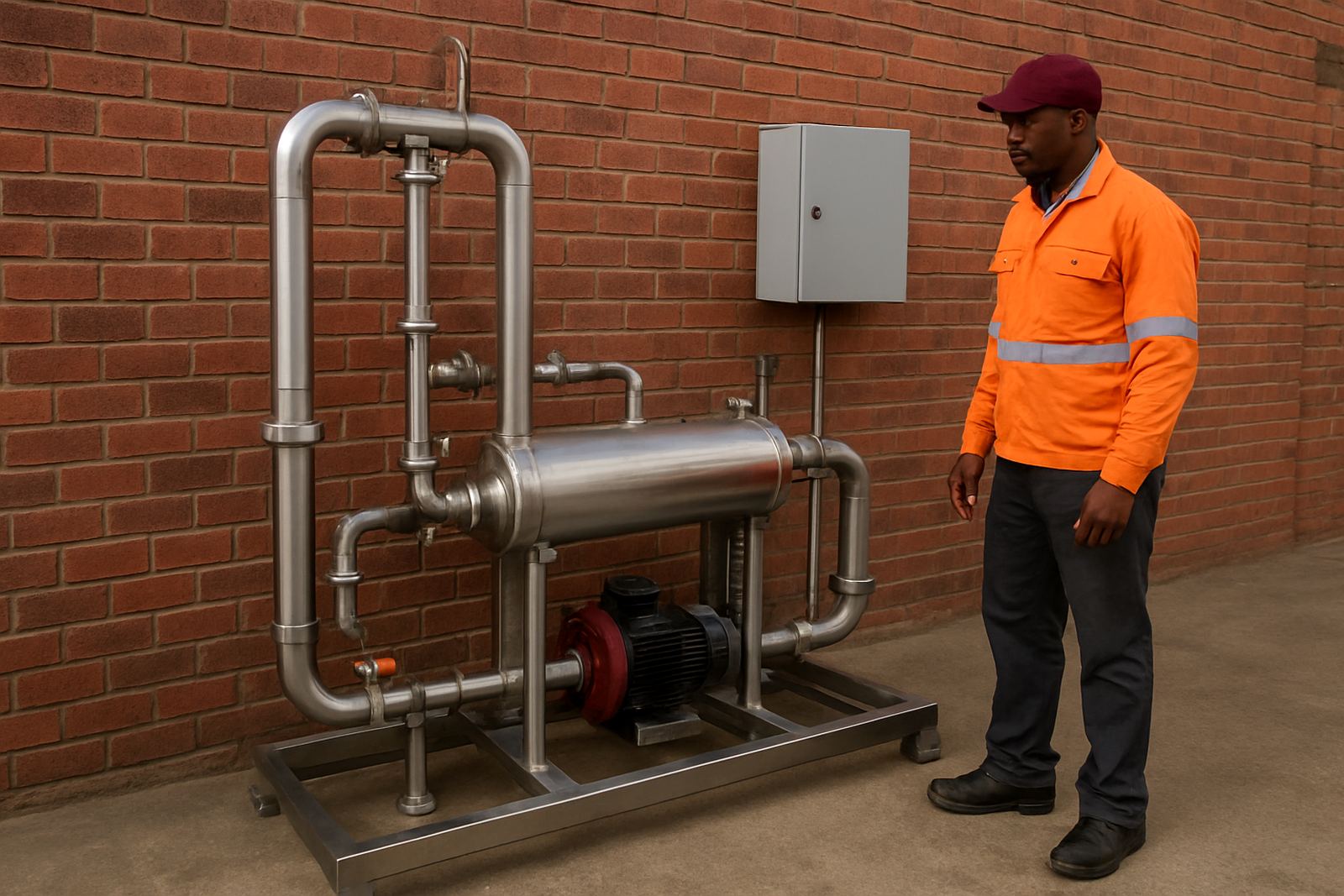
For harder water areas or sites with irregular maintenance, it is worth choosing a unit that allows easier descaling and access to elements, sensors and the heating chamber. On some installations, a plate heat exchanger arrangement may be more practical than direct element heating, especially where water treatment is not consistent.
Where inline heating works best
Inline water heaters suit places where there is no room for a large geyser bank or where hot water demand is spread through the day. They are also useful where water is needed at a fixed point and temperature stability matters, such as cleaning stations or clinical and food-related wash areas. If the line is close to the outlet, recovery is faster and wastage at the tap is reduced.
- Factories with handwash points and light process washing.
- Commercial kitchens, prep areas and pot wash stations.
- Workshops, depots and wash bays with limited plant room space.
- Ablution blocks at warehouses, schools and contractor sites.
- Refurbishments where the existing hot water plant is too large, too slow or too expensive to run.
We often see these units chosen in Boksburg, Kempton Park, Germiston and Midrand where space is already taken up by pumps, filtration, switchgear and ducting. On coastal or humid sites, correct enclosure rating and cable routing matter as much as the heater itself.
Installation needs and utility connections
Correct installation starts with the water supply, the duty cycle and the available power or gas. An inline heater should not be fitted on a line that cannot maintain enough flow, and it should never be left without proper pressure control, isolation valves and safety relief where required. If the plant has frequent voltage dips or generator changeover, the control arrangement must be checked before commissioning.
Electrical units need a supply sized for the load, with cabling, breaker selection and earthing matched to the actual duty. Gas-fired units need compliant gas piping, ventilation and flue arrangements, plus safe access for service. In both cases, inlet strainers, backflow protection and shutoff valves should be arranged so the heater can be isolated for maintenance without shutting down the whole area. A tidy install saves time later, especially when a fault happens after hours and the service team has to get in quickly.
Care, servicing and longer life
Inline water heaters last longer when they are inspected before scale builds up and before small control faults become bigger failures. On sites with hard water, sediment and limescale can reduce heat transfer and increase power draw. That means higher running costs, slower heating and, eventually, element or chamber damage. Regular water treatment checks help a lot, and so does keeping a simple service record.
Our maintenance approach normally includes electrical inspection, thermostat testing, flow switch checks, leak checks, terminal tightening and cleaning of heat transfer surfaces where access allows. On gas units we also check ignition, burner condition, combustion settings and flue integrity. If the heater serves a critical area, keep one spare sensor or control item on site. It is a small precaution that can save a full shutdown, especially on a Friday afternoon when everyone wants hot water at once.
- Check for scale, leaking unions and corrosion on every service visit.
- Confirm outlet temperature under normal load, not only at idle.
- Test safety cut-outs and interlocks after maintenance.
- Review water treatment records where hardness or solids are high.
What to check before you order
Before ordering an inline water heater, it helps to know exactly what the site needs. The more accurate the information, the better the unit will perform and the fewer changes will be needed during installation. If you are replacing an old heater, bring the model details, the fault history and any photos of the connection points.
- Required flow rate in litres per minute and target outlet temperature.
- Incoming water temperature and whether the supply varies by season.
- Available electrical supply, gas supply or both.
- Space available for mounting, access and future servicing.
- Water quality, pressure and whether treatment is already in place.
- How many outlets will run at the same time and for how long.
If the heater must support a process line, staff ablutions and cleaning at the same time, tell us that upfront. A unit selected for handwashing alone may be too small once other loads are added. It is also worth stating whether the site is subject to municipal discharge rules or plant hygiene standards, because that can affect the final arrangement.
Key facts
| Product type | Inline water heater for direct flow heating |
|---|---|
| Typical flow range | 5 to 60 litres per minute, model dependent |
| Temperature rise | Sized to match inlet water temperature and outlet demand |
| Supply options | Single phase, three phase or gas-fired, subject to site conditions |
| Construction | Metal heater body with serviceable controls and safety devices |
| Typical use | Commercial and industrial hot water points with limited storage |